
How to Choose the Right Mobile Workstation or Heavy Duty Workbench for Your Malaysian Factory Floor
Why Workstation Selection Matters More Than Ever in Malaysia's Growing Industrial Sector
Malaysia’s manufacturing sector continues to expand and remains one of the country’s most important economic drivers. According to data from the Department of Statistics Malaysia, the manufacturing sector contributed approximately RM382 billion to Malaysia’s GDP in 2024, up from RM366.8 billion in 2023.
The sector also employs more than 2.4 million workers, reflecting the scale and operational complexity of Malaysia’s industrial landscape.
Source: https://www.dosm.gov.my/portal-main/release-content/gross-domestic-product-2024
As manufacturers scale production and improve operational efficiency, there is increasing pressure to extract more productivity from existing factory floor space.
The workstation sitting at the centre of your assembly line, packaging zone or inspection bay is no longer just a flat surface. It is a productivity tool.
Choosing between a mobile workstation and a heavy-duty workbench or understanding when your facility needs both, is one of the most practical decisions a production or facility manager can make.
This guide explains how to make that choice based on task type, load requirements, floor layout and workforce needs.
Understanding the Core Difference - Mobile Workstations vs Heavy Duty Workbenches
Before exploring specific configurations, it helps to understand what separates these two workstation categories at a functional level.
Mobile Workstations
Heavy Duty Workbenches
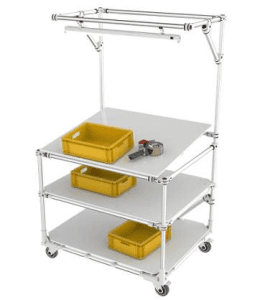
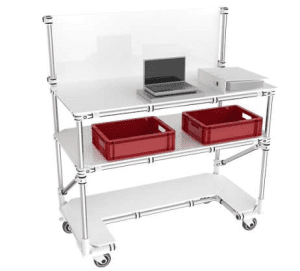
A mobile workstation is built for flexibility and movement across the factory floor.
It moves with the work.
When teams need to reposition between production zones, support changing assembly sequences or follow a product down a line rather than remain fixed in one location, mobility becomes the defining feature.
These units typically ride on industrial castor wheels, often with braking mechanisms that allow the workstation to be locked securely in place once it has been positioned. This allows operators to maintain stability during tasks while still benefiting from mobility when the workflow changes.
Mobile workstations are commonly used in environments where tasks shift frequently, tools must travel with technicians or production layouts are adjusted to accommodate different product lines.
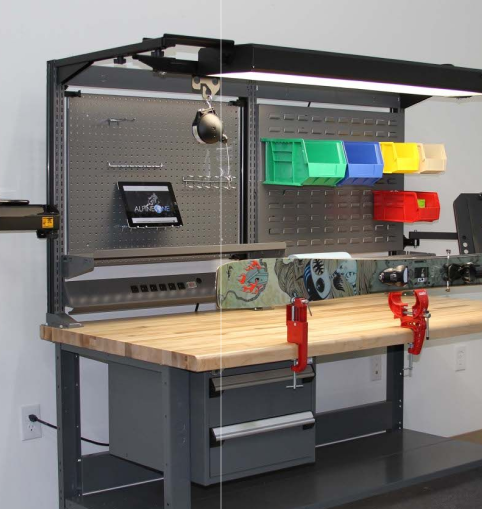
A heavy duty workbench is designed for stability, durability and high load capacity.
Unlike mobile workstations, these benches remain fixed in one location and are intended to support heavier components, specialised tools and continuous work throughout long production shifts.
Heavy-duty workbenches typically feature reinforced steel frames, rigid structural supports and adjustable feet to ensure the workstation remains stable even when handling demanding tasks.
Typical applications include quality inspection stations, complex assembly operations, testing and calibration benches and dedicated production cells.
Because they serve as permanent workstations, heavy-duty workbenches are often integrated with accessories such as shelving, lighting or tool holders to create a complete and organised working environment.
Neither option is universally better. The correct choice depends entirely on the operational requirements of your facility.
When a Mobile Workstation in Malaysia Is the Smarter Choice
Operations With Flexible or Rotating Work Zones
If your production layout changes frequently, supports multiple product lines or involves teams rotating between stations, a mobile workstation allows work areas to be reconfigured quickly.
Instead of moving tools and materials across the factory floor, the workstation itself can be repositioned where the task is currently happening.
This flexibility is particularly valuable in small and medium-sized manufacturing environments, where floor space often needs to support multiple activities across different shifts.
Maintenance, Repair and Field Support Teams
Maintenance technicians and quality assurance personnel often move between different areas of a factory.
A mobile workstation allows tools, diagnostic equipment and documentation to travel with the technician, reducing unnecessary trips to central storage areas and improving response time during repairs or inspections.
Lean Production Environments
In facilities applying lean manufacturing principles, reducing unnecessary movement of workers and materials is an important operational objective.
Mobile workstations help minimise this waste by bringing tools and materials directly to where they are needed, improving workflow efficiency and reducing unnecessary travel across the production floor.
When a Heavy Duty Workbench in Malaysia Is the Right Investment
High-Load Assembly and Component Preparation
If your operation regularly handles heavy components or subassemblies, a stationary heavy-duty workbench provides the stability required for safe and reliable work.
These benches typically feature:
- reinforced steel frames
- non-slip adjustable feet
- higher load capacities across the worktop and shelving
Attempting to perform heavy assembly tasks on a mobile workstation can introduce risks such as surface deflection or unwanted movement during operation.
A properly specified heavy-duty workbench eliminates these issues and ensures a stable working platform.
Dedicated Inspection and Quality Control Zones
Inspection work often requires a stable, vibration-free surface.
When workers are measuring dimensions, checking tolerances or inspecting finished parts, even minor movement in the work platform can affect accuracy.
Stationary workbenches with rigid frames and adjustable feet provide the consistency needed for these tasks.
For inspection processes that require viewing components at different angles, a workbench with a tilting board can offer additional ergonomic advantages by bringing the work surface closer to the operator’s natural line of sight.
Permanent Production Stations Requiring Modular Accessories
In many manufacturing environments, a workstation functions as the centre of a broader ecosystem that includes:
- overhead task lighting
- tool holders
- parts bins
- shelving systems
Heavy-duty factory workbenches are often designed with modular accessories, allowing facilities to expand or modify the station as operational needs evolve.
This supports workplace organisation systems such as 5S, which aim to improve productivity by keeping tools and materials consistently organised and accessible.
What to Look for in Workstation Construction Quality
Worktop Material
Frame Material and Structural Design
Castor Wheel Specifications for Mobile Units
High-density polyethylene (HDPE) is commonly used in industrial workstations due to its durability and resistance to moisture and chemicals.
HDPE worktops are:
- impact resistant
- easy to clean
- resistant to corrosion and moisture
These properties make them suitable for humid industrial environments and operations where frequent cleaning is required.
The frame structure determines how well a workstation performs under continuous industrial use.
Common industrial designs use:
- coated steel tube frames
- corrosion-resistant joints
- rigid structural connections
These features help maintain stability when components are repeatedly placed, moved or assembled on the surface.
For mobile workstations, castor wheels are a critical safety component.
Industrial castors should be:
- rated above the expected load capacity
- equipped with reliable braking mechanisms
- suitable for epoxy-coated or concrete factory floors
Properly specified wheels ensure the workstation remains stable once positioned.
Matching Workstation Type to Industry in Malaysia
Different industries have different operational requirements.
Electronics and Semiconductor Assembly
Logistics and Warehousing
Automotive and Heavy Component Manufacturing
Food and Pharmaceutical Production
These environments often benefit from lightweight mobile workstations, which can be repositioned when production lines change or new products are introduced.
Packaging and fulfilment areas often require mobile packing stations that allow workers to manage multiple orders efficiently.
These operations typically require stationary heavy-duty workbenches capable of supporting large components and continuous assembly work.
Facilities in these sectors prioritise easy-clean surfaces and chemical resistance, making HDPE worktops a practical solution.
3D Tube Workstations - Built for Malaysian Industrial Conditions
3D Tube designs workstation systems based on lean material handling principles, where equipment is intended to reduce wasted motion, support ergonomic work practices and integrate smoothly with surrounding carts, racks and flow systems.
The workstation range includes several configurations such as:
- mobile packaging stations
- mobile workstations
- workbenches with tilting boards
- factory workstations
Each design supports different combinations of mobility, load capacity and task complexity.
These systems can be configured individually or deployed across multiple stations as production capacity expands under Malaysia’s industrial development initiatives such as the New Industrial Master Plan 2030.
Frequently Asked Questions (FAQs)
What load capacity do I need for a heavy duty workbench in Malaysia?
For general assembly and inspection, a worktop capacity of 100-150 kg combined with shelf capacity of 100 kg and a total load of 300-400 kg covers the majority of industrial tasks. For heavier fabrication or component staging work, confirm total load requirements before specifying a unit.
Can a mobile workstation in Malaysia be used on uneven factory floors?
Most mobile workstations are designed for level or near-level industrial floors. On uneven surfaces, braked castors may not hold as reliably. For slightly uneven surfaces, a factory workstation with adjustable non-slip feet provides better stability than a castor-wheel unit.
How does HDPE compare to stainless steel as a workbench surface material?
HDPE is lighter, quieter for components that should not be dropped onto hard metal surfaces and sufficient for most assembly and inspection loads. Stainless steel worktops are preferred in food-grade environments requiring steam cleaning or where sharp metal components are worked on intensively. For most Malaysian manufacturing and logistics environments, HDPE offers the better cost-to-performance balance.
Is a workbench with a tilting board suitable for seated operators?
Yes. The tilting board design is specifically valuable for seated or variable-height operation, as the angle adjustment brings the work surface into the operator’s natural line of sight without requiring forward lean. This directly addresses one of the leading causes of neck and upper back strain in quality inspection roles.