
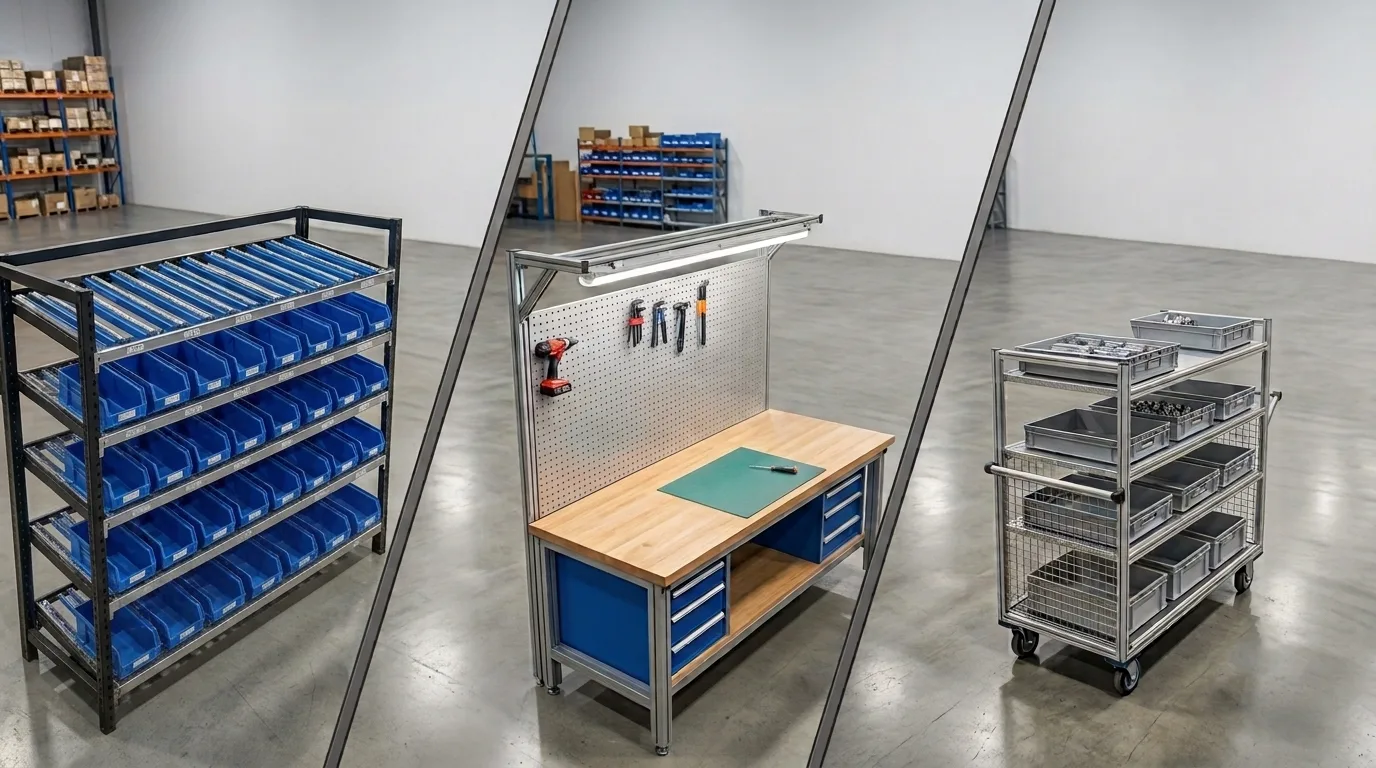
Flow Racks vs Worktables vs Industrial Trolleys: Which Solution Fits Your Production Line?
Modern manufacturing is no longer just about increasing production capacity. Businesses are also looking for ways to improve workflow, reduce unnecessary movement, optimise floor space, and ensure materials are always available when operators need them.
One common challenge is deciding which workplace equipment best supports these objectives. While flow racks, industrial worktables, and industrial trolleys all contribute to more efficient operations, they serve different purposes within a production environment.
Rather than viewing them as competing products, manufacturers should consider how each solution supports different stages of material handling and production. Selecting the right equipment for the right application helps improve workplace organisation, reduce unnecessary handling, and create a smoother production flow.
This guide explains the role of each solution and when it is most suitable for your operation.
Understanding Production Flow
A production line involves much more than assembly or manufacturing. Materials need to move efficiently from receiving, storage, and preparation through production, inspection, packaging, and dispatch.
When material flow is interrupted, operators may experience:
- Waiting for parts
- Walking long distances to retrieve materials
- Searching for tools
- Temporary storage congestion
- Multiple handling of the same components
Improving production flow often starts with organising how materials are stored, transported, and presented to operators.
What Are Flow Racks?
Flow racks are storage systems designed to keep inventory organised while allowing materials to move from the loading side to the picking side.
Many manufacturers use flow racks to support First-In, First-Out (FIFO) inventory management, ensuring older inventory is consumed before newer stock where appropriate.
Flow racks are commonly positioned beside production lines to improve material availability without occupying excessive floor space.
Typical applications include:
- Assembly component storage
- Production line replenishment
- Kanban systems
- Pick-and-pack operations
- Small parts organisation
Instead of operators walking to central storage locations, frequently used components remain close to the workstation, helping reduce unnecessary movement.
What Are Industrial Worktables?
Industrial worktables provide stable work surfaces for production, inspection, assembly, testing, and packaging activities.
Unlike ordinary tables, industrial worktables are designed to support demanding manufacturing environments and can be configured to suit different operational requirements.
Depending on the application, worktables may include:
- Adjustable shelving
- Storage accessories
- Tool holders
- Information boards
- Integrated storage
- Stainless steel surfaces for hygiene-sensitive environments
Because operators spend a significant portion of their working day at the workstation, selecting an appropriate worktable contributes to both organisation and productivity.
What Are Industrial Trolleys?
Industrial trolleys are designed to transport materials, tools, products, and equipment efficiently throughout a facility.
Instead of repeatedly carrying materials manually, operators can move larger quantities safely and consistently between workstations.
Different trolley configurations support different operational needs.
Examples include:
- Logistics trolleys
- Shelf trolleys
- Table trolleys
- Mobile carts
- Platform trolleys
- Custom production trolleys
Rather than functioning solely as transport equipment, many industrial trolleys become part of the overall production workflow.
When Should You Choose Flow Racks?
Flow racks are most suitable when your operation requires organised inventory presentation rather than transporting materials.
Consider flow racks if your business:
- Frequently replenishes production lines
- Uses repetitive assembly processes
- Wants to improve stock visibility
- Implements Lean manufacturing practices
- Requires FIFO inventory management
Flow racks are particularly effective when combined with logistics trolleys that replenish inventory throughout the day.
When Should You Choose an Industrial Worktable?
Industrial worktables are ideal when employees perform tasks at a fixed location.
Common applications include:
- Assembly stations
- Quality inspection
- Product testing
- Packing operations
- Electronics manufacturing
- Food processing work areas
- Engineering workshops
If the work remains stationary while materials move around it, a dedicated worktable usually provides the most suitable solution.
When Should You Choose an Industrial Trolley?
Industrial trolleys are most beneficial when materials regularly move between different locations.
Typical situations include:
- Transporting raw materials
- Moving work-in-progress between departments
- Delivering components to assembly lines
- Internal warehouse logistics
- Packaging and dispatch operations
- Mobile maintenance equipment
Businesses that rely heavily on manual carrying often benefit from introducing purpose-built trolley systems.
Comparing Flow Racks, Worktables and Industrial Trolleys
| Solution | Primary Purpose | Best For |
|---|---|---|
| Flow racks | Organised inventory presentation | Component storage, FIFO systems, production replenishment |
| Industrial worktables | Dedicated working surface | Assembly, inspection, testing, packing |
| Industrial trolleys | Material transportation | Internal logistics, production support, warehouse movement |
Each product addresses a different operational requirement, making them complementary rather than interchangeable.
Building an Efficient Production Line
Many manufacturers achieve better workflow by combining multiple workplace solutions instead of relying on a single product.
For example:
- Components are stored in flow racks beside the production line.
- Logistics trolleys replenish the racks throughout the day.
- Operators assemble products at ergonomic worktables.
- Finished products are transferred using industrial trolleys to the next process.
This approach reduces unnecessary movement while ensuring materials remain available where they are needed.
Instead of treating storage, transportation, and workstations as separate systems, integrating them creates a more organised production environment.
Why Customisation Matters
Every production facility has different space constraints, product sizes, and workflow requirements.
Standard equipment may suit general applications, but customised workplace solutions allow businesses to configure:
- Shelf layouts
- Dimensions
- Load capacities
- Storage accessories
- Wheel configurations
- Material types
- Work surface options
This flexibility enables workplace equipment to support existing production processes rather than requiring operators to adapt their workflow.
3D-Tube offers modular workplace solutions including flow racks, industrial worktables, mobile workstations, logistics trolleys, shelf trolleys, and other customised LEAN material handling systems that can be configured for different industries and production environments.
Choosing the Right Solution for Your Facility
There is no single product that solves every material handling challenge.
If your priority is organised inventory presentation, flow racks provide efficient storage and stock accessibility.
If operators perform repetitive assembly or inspection tasks, industrial worktables create organised and dedicated workspaces.
If materials need to move frequently between departments or production stages, industrial trolleys help improve internal logistics.
In many manufacturing environments, combining these solutions creates a more efficient workflow than relying on any single piece of equipment.
Conclusion
An efficient production line depends on more than machinery. The way materials are stored, transported, and presented to operators plays a significant role in supporting daily operations.
Flow racks, industrial worktables, and industrial trolleys each serve different purposes, but together they create a workplace that supports smoother production flow, better organisation, and improved material handling.
By understanding how these solutions complement one another, manufacturers can select workplace equipment that matches their operational requirements today while remaining flexible for future growth.
Frequently Asked Questions (FAQs)
Should I invest in flow racks or industrial trolleys first?
It depends on your biggest operational challenge. If operators spend time searching for or accessing components, flow racks may deliver greater improvements. If materials frequently move between departments, industrial trolleys are typically the better first investment. Many facilities eventually use both solutions together.
Can flow racks and industrial trolleys be used together?
Yes. A common approach is to use logistics trolleys to replenish flow racks throughout the day. This keeps production lines supplied with materials while reducing unnecessary trips to the warehouse and supporting a more organised workflow.
When is a mobile workstation a better choice than a standard worktable?
A mobile workstation is suitable when assembly, inspection, or maintenance tasks need to be performed in different locations. Standard industrial worktables are generally better for fixed workstations where the work area remains in one place.
How do I choose the right industrial trolley for my production line?
Start by identifying what needs to be transported, the load capacity required, travel distance, aisle width, and how often the trolley will be used. Choosing a trolley that matches your workflow is usually more effective than selecting based solely on size or price.
Can workplace equipment be customised to fit our existing production layout?
Yes. Many manufacturers choose customised flow racks, worktables, and industrial trolleys to match available floor space, product dimensions, and operational processes. Modular solutions also make it easier to adapt equipment as production requirements change.