
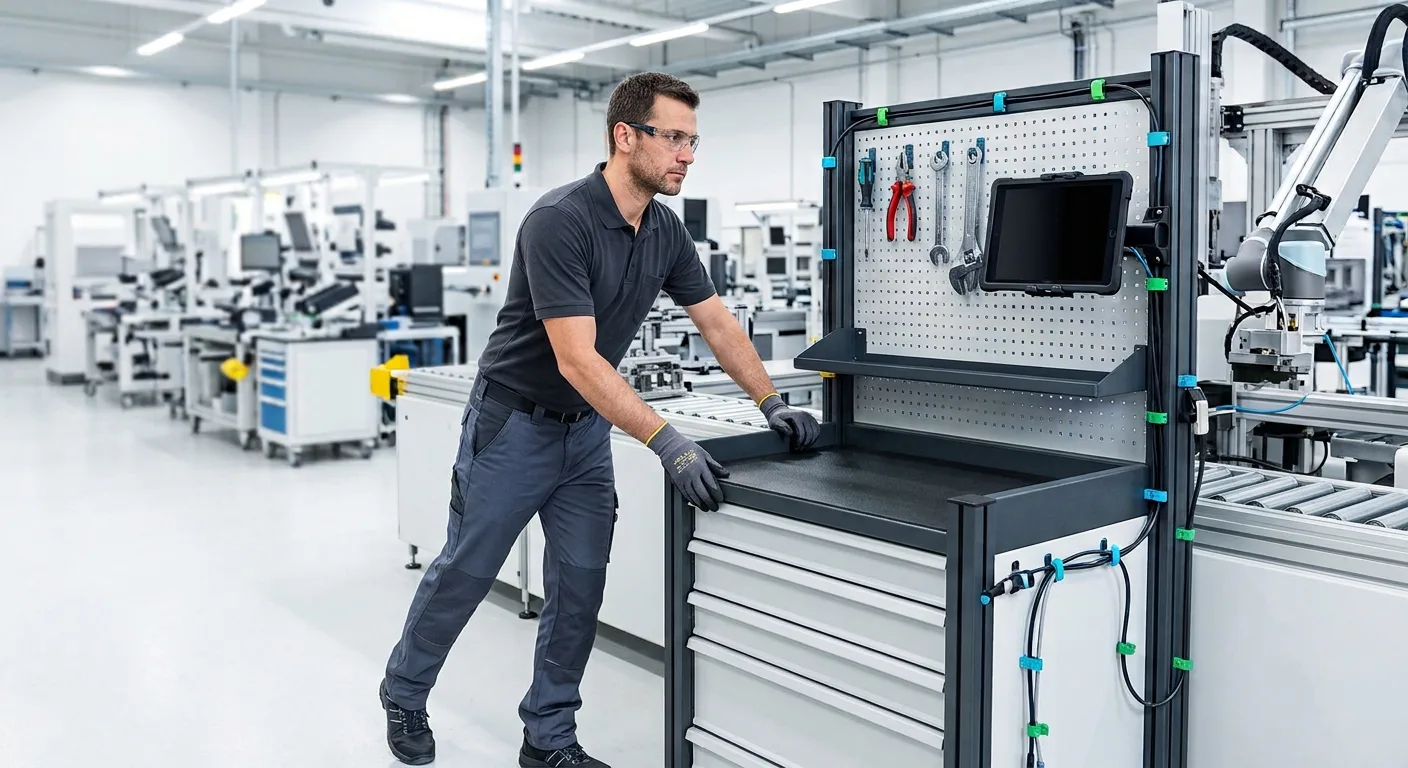
How Mobile Workstations Support Lean Manufacturing and Continuous Improvement
Lean manufacturing is not simply about producing more in less time. It is a systematic approach to improving processes by eliminating activities that do not add value, creating smoother workflows, and enabling teams to work more efficiently.
While Lean initiatives often focus on production equipment and process improvements, the design of the workplace itself plays an equally important role. Poor workstation layouts, unnecessary movement, and disorganised tools can all reduce productivity and create avoidable interruptions throughout the production process.
Mobile workstations have become an increasingly practical solution for manufacturers looking to create flexible production environments that support continuous improvement. By allowing workstations to move where they are needed and by keeping tools, materials, and equipment organised, businesses can better adapt to changing production requirements without major facility modifications.
Understanding Lean Manufacturing Beyond Waste Reduction
Lean manufacturing focuses on delivering value to customers while reducing activities that consume time, labour, and resources without contributing to the final product.
In practical terms, Lean encourages manufacturers to improve how work is performed by simplifying processes, organising workplaces, and making material flow more efficient.
Examples of common operational challenges include:
- Operators walking long distances to retrieve tools.
- Components stored away from the point of use.
- Workstations that cannot adapt to changing production requirements.
- Equipment that remains underutilised because it cannot be relocated.
- Temporary work areas created whenever production demand changes.
Addressing these challenges often begins with improving the flexibility of the workplace rather than investing immediately in new production machinery.
Why Fixed Workstations Can Limit Production Flexibility
Traditional workbenches remain suitable for many manufacturing applications. However, production environments continue to evolve as manufacturers introduce new products, modify assembly processes, and optimise factory layouts.
A fixed workstation may become less efficient when:
- Production lines are reconfigured.
- Product sizes change.
- Teams require temporary assembly areas.
- Inspection stations need to relocate.
- Maintenance work is performed throughout the facility.
When workstations cannot adapt to operational changes, businesses may spend additional time moving materials instead of bringing the workstation closer to the work.
What Is a Mobile Workstation?
A mobile workstation combines an ergonomic work surface with integrated storage and mobility.
Unlike a standard table or workbench, a mobile workstation allows operators to transport tools, components, documentation, and equipment directly to the point of use.
Depending on operational requirements, mobile workstations may include:
- Adjustable shelving
- Storage compartments
- Tool holders
- Information boards
- Lockable castors
- Modular accessories
- Custom configurations
This flexibility allows manufacturers to support different production processes without permanently redesigning their workspace.
Supporting Point-of-Use Operations
One of the key principles of Lean manufacturing is ensuring that materials and equipment are available where they are needed.
When operators repeatedly leave their workstation to collect tools or components, production flow becomes interrupted.
A mobile workstation helps support point-of-use operations by keeping frequently used items within immediate reach.
Benefits include:
- Reduced operator movement
- Improved workplace organisation
- Faster task preparation
- Easier access to production tools
- Better visibility of materials and documentation
Instead of transporting components back and forth between work areas, the workstation itself becomes part of the production process.
Improving Production Flow Through Mobility
Production flow depends on how efficiently materials and operators move throughout the workplace.
Mobile workstations can support smoother operations by allowing workstations to be repositioned as production requirements change.
Examples include:
Assembly Operations
Workstations can be relocated closer to production cells when introducing new product lines.
Maintenance Activities
Maintenance personnel can transport tools and spare parts directly to equipment rather than returning repeatedly to a fixed tool room.
Quality Inspection
Inspection equipment can be positioned near production to reduce unnecessary product movement.
Packaging Areas
Temporary packing stations can be established during periods of increased production demand.
This flexibility helps manufacturers respond more efficiently to operational changes.
Supporting Continuous Improvement
Continuous improvement involves making ongoing adjustments that gradually enhance operational performance.
Because mobile workstations are modular, businesses can modify workstation layouts as production requirements evolve.
Examples include:
- Adding storage shelves
- Repositioning accessories
- Expanding workspace
- Installing document holders
- Changing workstation dimensions
- Integrating additional storage solutions
Rather than replacing equipment whenever processes change, manufacturers can adapt existing workstations to support new workflows.
Integrating Mobile Workstations with Other LEAN Solutions
Mobile workstations provide the greatest value when integrated with other workplace organisation systems.
For example:
- Flow racks maintain organised component storage beside production lines.
- Logistics trolleys replenish materials throughout the day.
- Industrial worktables support fixed assembly stations.
- Shelf trolleys improve order picking and material transportation.
- Stainless steel worktables provide hygienic work surfaces for specialised industries.
By combining these workplace solutions, manufacturers can create a more organised production environment where materials move efficiently and operators spend more time performing value-added work.
Why Customisation Matters
No two production facilities operate exactly the same way.
Differences in products, floor layouts, production volumes, and workflow requirements mean that workplace equipment often needs to be tailored to the application.
Customisable mobile workstations allow businesses to configure:
- Work surface dimensions
- Shelf layouts
- Storage accessories
- Wheel types
- Load capacities
- Information boards
- Tool storage systems
This flexibility helps ensure the workstation supports the production process rather than restricting it.
3D-Tube offers modular mobile workstations that can be customised alongside complementary LEAN workplace solutions such as logistics trolleys, worktables, and flow racks to support different manufacturing environments.
Choosing a Mobile Workstation for Long-Term Flexibility
When selecting a mobile workstation, businesses should consider more than immediate operational needs.
Questions worth evaluating include:
- Will the workstation support future production changes?
- Can accessories be added later?
- Does it integrate with existing workplace systems?
- Is it suitable for the available floor space?
- Can it be reconfigured if production expands?
Considering long-term adaptability often provides greater value than selecting equipment based solely on today’s requirements.
Conclusion
Lean manufacturing is built on continuous improvement, workplace organisation, and efficient material flow. While machinery plays an important role, the flexibility of the workplace should not be overlooked.
Mobile workstations allow manufacturers to create adaptable production environments where tools, materials, and operators can work together more efficiently. When integrated with flow racks, logistics trolleys, and industrial worktables, they become part of a broader workplace strategy that supports smoother production flow and future operational improvements.
Investing in adaptable workplace solutions today helps manufacturers build production environments that remain efficient as business requirements continue to evolve.
Frequently Asked Questions (FAQs)
What makes a mobile workstation better than a fixed workbench in a Lean manufacturing environment?
A mobile workstation allows tools, components, and equipment to be moved closer to where work is performed, reducing unnecessary operator movement. This flexibility is particularly useful when production layouts change or multiple work areas share equipment.
Which industries benefit most from mobile workstations?
Mobile workstations are widely used in manufacturing, electronics assembly, automotive production, warehousing, maintenance, packaging, and quality inspection. Any operation that values flexible workflows and organised workspaces can benefit from mobile workstation solutions.
Can mobile workstations be customised for different production processes?
Yes. Many mobile workstations can be configured with adjustable shelves, storage compartments, tool holders, information boards, and different work surface sizes. Customisation helps ensure the workstation matches specific operational requirements.
How do mobile workstations work together with flow racks and logistics trolleys?
Flow racks keep components organised at the production line, logistics trolleys replenish materials, and mobile workstations provide a flexible space where operators can perform assembly or inspection tasks. Together, they support a smoother and more organised production flow.
What should I consider when selecting a mobile workstation?
Evaluate the workstation’s load capacity, mobility, available storage, work surface size, compatibility with your production layout, and whether it can be expanded or reconfigured as your operational requirements change.